What Is a Mailing Address? Mailing vs Physical vs Billing Address

A mailing address is where you receive mail. For a business it can be a street address, a PO box or a private mailbox. It does not have to be the place where you work, and it is not the same thing as your billing address or the address your state has on file for your registered agent.
The main finding is simple: each address answers a different question. Pick the one that matches what the reader of the form, invoice or card record needs to do with it.
What Is a Mailing Address?
Your mailing address is the address for your correspondence. On IRS Form SS-4, the instructions say the mailing address is for the entity's correspondence, and that the IRS will generally use it on all tax returns. A P.O. box is allowed there.

That makes it the address where tax notices and letters will land. If you work from job sites or a shared space, a mailing address gives you one stable place to receive them.
Mailing vs Physical vs Billing vs Registered Address

| Address | What it is | Where it matters |
|---|---|---|
| Mailing | Where you receive mail | IRS correspondence, general mail, legal documents |
| Physical | The street address of the business | SS-4 lines 5a-5b, no P.O. box allowed |
| Billing | The address a bank or card issuer has on file for a card or account | Card payments and address checks |
| Registered agent | The address filed with the state for legal notices | State filings, with state-specific rules |
Stripe describes a billing address as the one tied to the person or business that owns a card or account. It is different from a shipping address, which is where physical goods go. A billing address belongs to the card, not to your workplace.
It matters at checkout because of the Address Verification Service (AVS). Stripe says AVS often needs only the street number and the ZIP or postal code. The issuer compares them with the address on file and returns a result such as full match, partial match, no match or unavailable. In the Visa Acceptance (Cybersource) domestic codes, Y means street and 5-digit ZIP match, Z means only the ZIP matches, A means only the street matches, and N means neither matches.
Which Address to Use on IRS and State Forms
On Form SS-4, lines 4a-4b take the mailing address. Lines 5a-5b take the street address, which is the physical address. You enter it only if it differs from the mailing address, and you must not enter a P.O. box number.

If your mailing address changes later, the SS-4 instructions say to file Form 8822-B. The 60-day deadline in those instructions applies to changes of the responsible party, not to address changes.
State rules for registered agents are stricter than the IRS rules:
- Washington: the registered agent address must be a physical street address in the state. P.O. boxes, private mailboxes and virtual real addresses are not allowed. An alternate mailing address can be added only in addition to the physical one.
- Washington principal office: this must be the business's street address. A P.O. box or private mailbox can be given only as an alternate mailing address.
- Colorado: the registered agent needs a physical street address in Colorado, at a place customarily open during normal business hours. A separate registered agent mailing address may be a commercial address or P.O. box, but it must also be in Colorado.
If you have no physical address in Washington, you can hire a commercial registered agent to supply one.
How to Format a US Mailing Address
USPS Publication 28 shows the address block as three parts: the Recipient line, the Delivery Address line and the Last line. Keep them complete and use USPS abbreviations. Uppercase is preferred on every line. Except for the hyphen in the ZIP+4 code, punctuation may be left out.
For a business with a suite, a standard block looks like this:
- Line 1: ACME PLUMBING LLC
- Line 2: 123 MAIN ST STE 200
- Line 3: SPRINGFIELD IL 62701-1234
Put the unit at the end of the Delivery Address line. Use the proper designator, such as APT, BLDG, FL, STE, UNIT, RM or DEPT, and do not use the pound sign if you know the correct one. If the line cannot hold everything, put the secondary information on the line directly above it. An attention line goes above the Recipient line, above the firm name.
PO Boxes, Street Addressing and Private Mailboxes
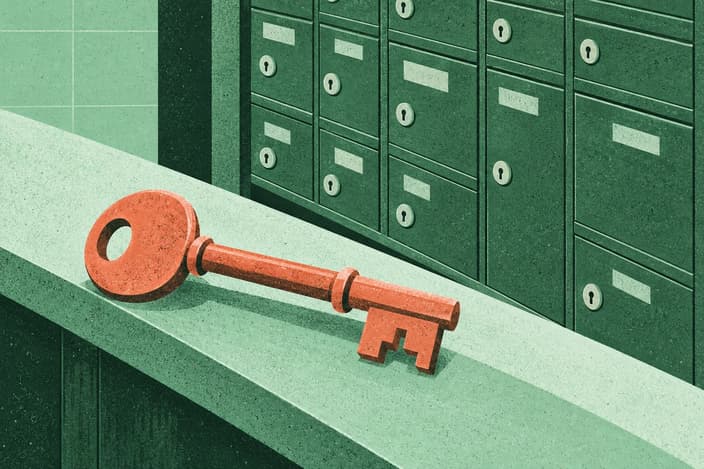
A USPS PO Box is a locked, numbered box inside a Post Office. You apply with PS Form 1093 and two forms of acceptable ID. You can rent a box in another city or state, but you must visit that Post Office in person to collect the keys.
Most Post Offices offer 5 sizes, from XS (holds 10-15 letters) to XL (big enough for multiple packages). Terms are 3, 6 or 12 months. A 3-month term renews automatically with no opt-out, while 6- and 12-month terms let you opt out. Prices depend on the Post Office's fee group, box size and term.
Data Table
| Box size | Fee group 7 (lowest) | Fee group 1 (highest) |
|---|---|---|
| Size 1 (XS) | 31 | 81 |
| Size 2 (S) | 41 | 118 |
| Size 3 (M) | 60 | 206 |
| Size 4 (L) | 90 | 355 |
| Size 5 (XL) | 156 | 553 |
Source: USPS, PO Box Service prices 2026 (CSV).
The same size can cost very different amounts. An XS box runs $31 to $81 for six months, and an XL box runs $156 to $553.
Street Addressing is an optional add-on at some locations. You use the Post Office's street address plus your box number, which lets you receive packages from UPS, FedEx, DHL and Amazon if they follow USPS mailing standards. If you use both a street address and a PO Box, Pub 28 says to avoid dual addresses if possible. When you must, the intended delivery address, normally the PO Box, goes on the line directly above the city, state and ZIP+4.
A commercial mail receiving agency (CMRA), such as Mail Boxes Etc., PostNet or Postal Annex, accepts USPS mail for you in a private mailbox. You complete PS Form 1583 with two forms of ID, one with a photo, and pay the CMRA's own fees. Registered Mail must be accepted at the local Post Office. Mail can be forwarded to a CMRA but not from one, and when a box ends the CMRA must forward mail for 6 months.
International Address Formats
Formats vary widely. Smarty, citing the Universal Postal Union, reports more than 200 address formats worldwide and at least 20 scripts.
- Canada: a civic address has three lines: addressee, civic address, then municipality, province or territory and postal code. A block cannot exceed six lines. The postal code is uppercase with a space in the middle, so T0L-1K0 is not acceptable. Avoid the # symbol and use a hyphen between the unit number and street number.
- United Kingdom: per Smarty's description of Royal Mail practice, one item per line: premise and thoroughfare, locality, then postcode. Domestic mail omits the country. International mail adds it on the last line.
- Japan: Japan Post asks for English letters and Arabic numerals in five rows: name; building name and room number; house number, street and town or village; city and prefecture; postal code and country.
When to Put a Mailing Address on Your Invoices
Xero says every invoice should start with the legal business name, address, phone number and email. If you use a trade name or DBA, include both names. It also says the US has no federal invoicing laws, so requirements come from state and local rules.
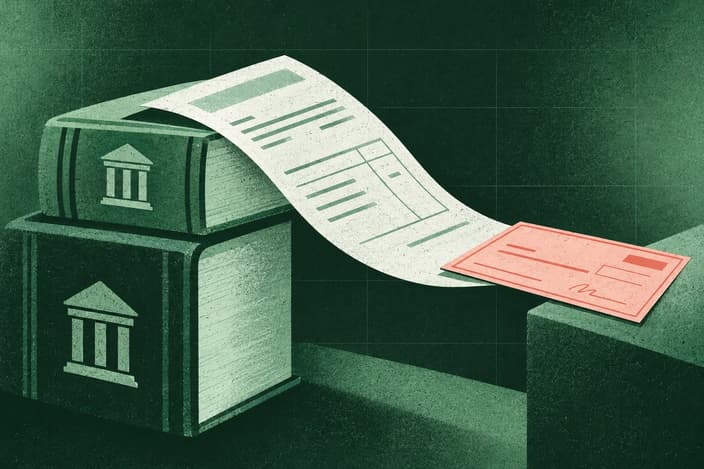
A mailing address does a different job: it tells customers where to send checks. QuickBooks suggests giving instructions for the chosen payment method, such as a mailing address for checks. Dun & Bradstreet adds that you should name who the check is payable to, either your name or the business name if you have a business bank account.
A separate remit-to address helps in some cases. SoFi says it is the address you designate for payments, and it may be a P.O. box, a bank-managed lockbox or a dedicated accounts receivable location. InvoiceZip says it is useful when payments are processed elsewhere, when you use a PO box for mailed payments, or when you use a lockbox. If checks come to your normal address, you can use that.
J.P. Morgan explains that with a lockbox, customers send checks to a secure PO box managed by your bank, which collects, processes and deposits them. That speeds up check processing but carries setup costs and ongoing fees.
The rule of thumb: show your legal name and business address at the top, and add a remit-to address in the payment instructions only if checks go somewhere other than that address. Whatever tool you use to send invoices, including PineBill, check that the address in the payment instructions is the one where you actually collect mail.
Sources
- IRS — Instructions for Form SS-4 (12/2025)
- IRS — Form SS-4 (Rev. December 2025)
- Washington Secretary of State — Contact Info Requirements & Updates
- Washington Secretary of State — Registered Agents
- Colorado Secretary of State — Registered Agent Business FAQs
- Stripe — What is a Billing Address and Why Does It Matter?
- Visa Acceptance Support Center (Cybersource) — Address Verification Service (AVS) knowledge article
- USPS Postal Explorer — 2 Postal Addressing Standards
- USPS Postal Explorer — 213 Secondary Address Unit Designators
- USPS Postal Explorer — 214 Attention Line
- USPS Postal Explorer — 215 Dual Addresses
- USPS Postal Explorer — 222 Punctuation
- USPS — Rent a PO Box
- USPS — PO Box Service prices 2026 (CSV)
- USPS — Commercial Mail Receiving Agency (CMRA)
- Canada Post — Addressing guidelines: Canadian addresses
- Canada Post — Addressing guidelines: Civic address
- Smarty — International address formats
- Japan Post — How to write an address label for international mail
- Xero US — What to include on an invoice: a complete guide for small businesses
- QuickBooks — Free Professional Invoice Templates 2026
- Dun & Bradstreet — Invoicing and Check Writing
- SoFi — What are the Key Aspects of a Remittance Address?
- InvoiceZip — What is a Remittance Address
- J.P. Morgan — Bank Lockbox Services: How They Work & the Benefits
Last updated: November 2026. USPS prices and state requirements may change, so check the current source before you file or sign up.