How to Write a Contractor Estimate: Waste, Allowances and Contingency (2026)

A contractor estimate is built line by line, not from one price per square foot. This guide covers each line, with worked numbers.
Input prices rose over the year to September 2026, and confusing markup with margin cuts profit. In the worked example below, a 20% markup instead of a 20% margin loses 3.3 points of profit.
Data note: Price figures cover September 2025 to September 2026 (AGC) and August 2026 (ABC). The lumber duties were set on October 13, 2026. Wage and benefit figures are for June 2026. NAHB remodeler margins are for fiscal 2024, and CFMA figures are for fiscal year 2025 (2026 Benchmarker). Waste factors are common trade practice, not published standards.
Start With Scope and Net Quantities
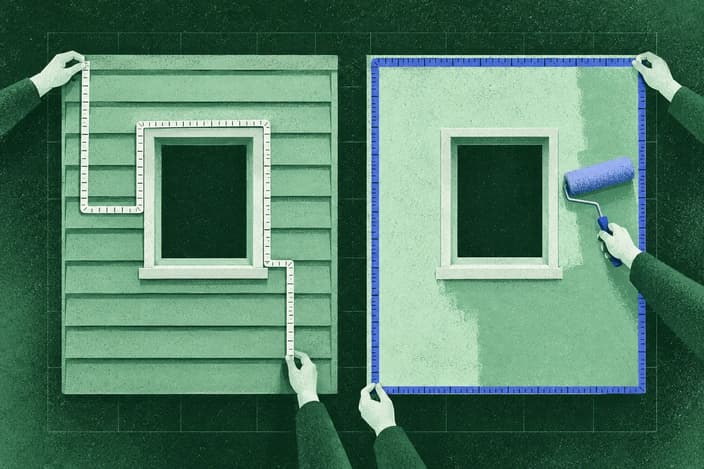
Write the scope first, then measure net quantities: the area or count that ends up in the finished work, with nothing added. Waste, labor and price all hang off this number. For drywall and siding, deduct openings. For paint, do not.
Build the estimate in this order:
- Net quantity for each material.
- Waste factor for each material.
- Current supplier prices.
- Allowances for client-selected items.
- Labor from production rates plus burden.
- Overhead and profit.
- Contingency.
- Validity and change-order terms.
Add Waste Material by Material
Apply the waste percentage to the net measured area, then round up to whole boxes, bundles or pallets. Do not stack waste factors if your calculator already applies one.
Tallyard's reference gives a standard and a complex figure for each material, shown below. These are common contractor practice, not published standards.
Data Table
| Material | Standard layout | Complex layout |
|---|---|---|
| Interior paint | 5 | 10 |
| Drywall | 10 | 15 |
| Tile, straight lay | 10 | 15 |
| Tile, diagonal or herringbone | 15 | 20 |
| Hardwood, straight | 10 | 15 |
| Hardwood, diagonal | 15 | 20 |
| Framing lumber | 10 | 15 |
| Roofing, simple gable | 10 | 12 |
| Roofing, hips and valleys | 15 | 20 |
| Concrete | 5 | 10 |
| Sod | 5 | 10 |
| Mulch and gravel | 5 | 10 |
Source: Tallyard, Construction Waste Factor Reference (common trade practice, not published standards).
Other sources differ from the chart, and from each other. An engineered hardwood installation guide from a flooring manufacturer, paraphrasing NWFA guidelines, recommends adding 5% to 15%, a wider range than the chart's 10% to 15% and 15% to 20%. PILARS puts drywall waste at 6% to 8% on simple walls and 10% to 12% on complex walls or ceilings, against 10% and 15% in the chart.
Roofing is split differently by each source. Tallyard's chart lists a simple gable at 10% to 12% and groups hips and valleys at 15% to 20%. A roofing calculator source separates the cases: 10% for a simple gable, 12% to 15% for a hip roof and up to 20% for a cut-up roof. The categories do not map one to one, so note which source and category you used.
Example: 1,000 square feet of net drywall at 10% waste means you buy 1,100 square feet. Waste is a material cost only. Crews install net square feet, so do not apply the waste factor to labor hours.
Price Materials at Today's Supplier Costs
Do not reuse last year's prices. AGC's producer price index for inputs to new nonresidential construction rose 11.9% from September 2025 to September 2026, and AGC says contractors are largely absorbing the increases because demand is soft. ABC found input prices up 1.2% in August from July and 8.9% higher than a year earlier, with iron and steel, softwood lumber, switchgear and copper wire and cable each up more than 10%.


Data Table
| Input | Year-over-year change |
|---|---|
| Copper and brass mill shapes | 30.0 |
| Steel mill products | 27.6 |
| Aluminum mill shapes | 25.2 |
| Precast concrete | 10.5 |
Source: Associated General Contractors of America (AGC), October 2026.
Lumber is a moving target. On October 13, 2026, Commerce set antidumping and countervailing duties on Canadian softwood lumber at 24.75%, down from about 35.16%. A separate 10% Section 232 tariff still applies, for total duties of 34.75%. Get written supplier quotes close to the day you send the estimate.
Set Allowances for Client-Selected Finishes
Under AIA A201, an allowance is a placeholder dollar amount for an item whose exact cost cannot be set at bid time. It covers only materials or equipment delivered to the site, including taxes, less trade discounts. Labor, installation, overhead and profit stay in the contract sum.
The difference is settled by change order. With a $10,000 flooring allowance, flooring that costs $12,000 means a $2,000 increase. Flooring that costs $8,500 means a $1,500 decrease.
Check your state's model language. California's CSLB model contract says allowances include overhead, profit and applicable sales taxes, unlike AIA A201. State which approach you use, and sign any change order before the work starts.
Build Labor From Production Rates and Burden
Start with hours. PILARS, citing AWCI and contractor manuals (not verified), gives drywall hanging at 0.008 to 0.014 hours per square foot. Condition multipliers apply: ceilings over 12 feet at 1.2 to 1.5, cut-up rooms at 1.15 to 1.3, and occupied renovation at 1.3 to 1.8.
For 1,000 net square feet, hanging takes 8 to 14 hours. On a high ceiling, multiply by 1.2 to 1.5, which gives about 9.6 to 21 hours.
Then price the hour with burden. BLS data for private construction workers, June 2026:
| Item | Per hour worked |
|---|---|
| Wages | $36.13 |
| Benefits | $15.84 |
| Total compensation | $51.96 |
Benefits were 30.5% of total compensation, but as a markup on wages they are about 43.8% (15.84 divided by 36.13). Legally required benefits were about 12.2% of wages. The employer share of FICA alone is 7.65%. These are calculations from averages, so use your own actual costs. At $51.96 per hour, 8 hours costs $415.68 and 14 hours costs $727.44.
Add Overhead and Profit Without the Markup Trap
Markup is profit divided by cost. Margin is profit divided by price. A $100 cost sold at $125 is a 25% markup but a 20% margin. To hit a target margin, use markup = margin divided by (1 minus margin).

Data Table
| Target margin | Required markup |
|---|---|
| 10% margin | 11.1 |
| 15% margin | 17.6 |
| 20% margin | 25.0 |
| 25% margin | 33.3 |
| 30% margin | 42.9 |
Source: Tasktag, Construction Overhead and Profit (2026).
Example: a job costs $50,000 and you want a 20% margin. A 25% markup gives a price of $62,500. A 20% markup gives $60,000, which is only a 16.7% margin, a shortfall of 3.3 points.
The "10 and 10" rule is a rule of thumb. Adding 10% and then another 10% is a 21% markup, about a 17.4% margin. Overhead and profit of 10% each as shares of price needs a 25% markup.
For a reality check, NAHB's remodeler study found an average net profit margin of 6.3% and gross margin of 29.9% (fiscal 2024). CFMA's 2026 Benchmarker, which reports fiscal year 2025, shows net income before tax of 6.8% of revenue across firms, 7.5% for specialty trades and 4.1% for residential. CFMA's sample skews to larger firms, so a small shop may see different results.
Size Contingency to the Risk
An allowance is a known item with an unknown price. A contingency is a reserve for unexpected costs that may or may not occur. AIA calls a 5% to 10% contractor contingency common in design-build, depending on risk, difficulty and complexity.
Projul gives ranges by project type, as a percent of project cost:
| Project type | Low | High |
|---|---|---|
| New residential | 5 | 7 |
| Standard remodel | 7 | 10 |
| Older or historic renovation | 10 | 15 |
| Incomplete drawings or design-build | 12 | 20 |
| Commercial tenant improvement | 8 | 12 |
Source: Projul, Construction contingency budget guide.
A Bolster blog rule of thumb is 5% to 10% for new construction and 10% to 20% for remodeling, with older homes at the high end. On an $80,000 remodel, 10% to 20% is $8,000 to $16,000.
The sources give different ranges. AIA's 5% to 10% for design-build sits below Projul's 12% to 20% for incomplete drawings or design-build. Both Projul and Bolster put older buildings at the higher end of their ranges.
Write Validity and Change-Order Terms
In a lump-sum contract the contractor usually bears material price risk. AGC advises shortening bid validity when prices are volatile, locking in supplier prices early, including a generous bid contingency, offering alternate materials and adding an escalation clause (day-one, threshold or delay type). That AGC source is a 2021 convention presentation, written before the 2025 to 2026 price moves in this article, so treat it as general guidance.

No primary source sets a standard validity period. One software vendor calls 30 days standard for residential work, which is opinion.
Check your state's contract rules:
- California: written contract over $500; down payment capped at the lesser of $1,000 or 10% of the price; written change orders signed before changes.
- New York: written plain-English contract for most work over $500, with make and model of materials and a three-business-day cancellation notice.
- Florida: an initial payment over 10% means applying for permits within 30 days and starting within 90 days after permits issue, unless there is just cause or written agreement.
- Texas: a disclosure statement before the contract, advising owners to reserve 10% of payments during construction and for 30 days after completion.
Once the numbers are settled, you can create and send the estimate in PineBill.
Sources
- Tallyard — Construction Waste Factor Reference: Every Material, One Table
- BHW Floors — Installation Guidelines (engineered wood flooring)
- Smart Roofing Calculator — Roof Waste Factor: 10% Gable, 12–15% Hip, 20% Cut-Up
- PILARS — Drywall Cost Estimating: Labor Rates, Material Prices, and Waste Factors
- Associated General Contractors of America (AGC) — Construction Input Costs Rise 11.9% From September 2025 To September 2026
- Associated Builders and Contractors (ABC) — Construction Materials Prices Jump Again in August
- National Association of Home Builders (NAHB) — U.S. Cuts Duties on Canadian Lumber
- Associated General Contractors of America (AGC) — Strategies to Mitigate the Risk of Material Price Escalation
- Jobkore — How to Write Estimate Terms and Conditions That Protect You
- AIA Contract Documents — Construction Allowances: What They Are and How AIA A201 Defines Them
- California Contractors State License Board (CSLB) — Contracting for Success
- American Institute of Architects (AIA) — Managing the contingency allowance
- Bolster — Residential construction contingency for general contractors
- Projul — Construction contingency budget guide
- U.S. Bureau of Labor Statistics — Table 4. Private industry workers by occupational and industry group, June 2026
- 6 Signal — Your Labor Burden Is Not 35%. The BLS Says the Floor Is 44%
- Internal Revenue Service — Topic no. 751, Social Security and Medicare withholding rates
- Procore — Markup vs. Margin
- Tasktag — Construction Overhead and Profit: How to Calculate Your Markup (2026)
- EstimationPro AI — Free Contractor Markup Calculator
- National Association of Home Builders (NAHB) — Home Remodeling Profit Margin Jumps on Demand and Business Practices
- Construction Financial Management Association (CFMA) — CFMA's 2026 Financial Benchmarker Executive Summary
- California Contractors State License Board (CSLB) — What is a contract (Home Improvement Contracts)
- New York State Senate — New York General Business Law §771
- Florida Legislature — Florida Statutes §489.126
- Texas Legislature — Texas Property Code §53.255
Last updated: November 2026. Price data runs through September 2026 and may change.