Card Surcharges on Invoices in 2026: What the Visa and Mastercard Settlement Changes
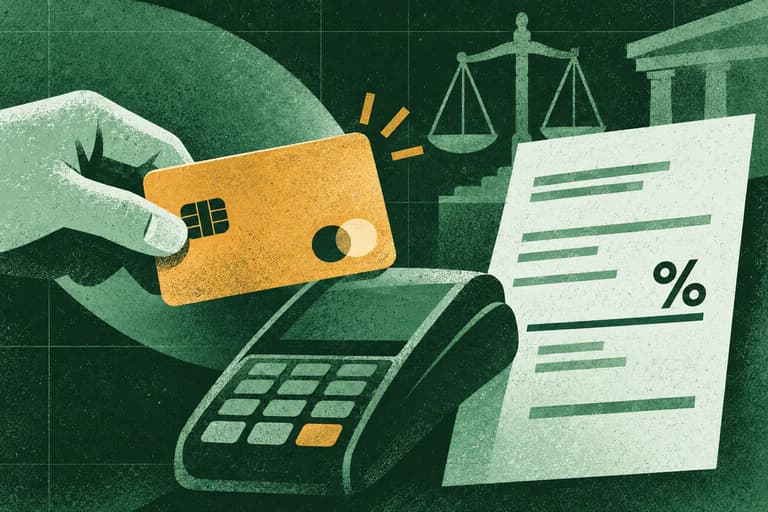
A credit card surcharge on an invoice comes with a cap, a notice period, disclosure rules and a handful of state bans. The Visa and Mastercard settlement would widen your options, but it is not final.
The main finding is that nothing changes for your invoices yet. The court gave preliminary approval in June 2026 and holds a final hearing on 16 Nov 2026. Until then, the current network rules and your state's law decide what you can charge.
This article covers where the settlement stands, what it would change, how to show a surcharge on an invoice, which states restrict surcharges, and when a cash discount fits better.
Data note: This article contains no year-to-date figures. The swipe fee and card fee totals are annual figures for the years shown. The settlement terms are preliminary, based on the court's preliminary approval in June 2026 and reports available through late October 2026. Network rules and state laws are the versions current at the time of writing.
Where the Visa and Mastercard Settlement Stands
Judge Brian Cogan granted preliminary approval to the settlement on about 9 June 2026. He found it fair, reasonable and adequate and said he was likely to grant final approval.

Preliminary approval is not final approval. The final approval hearing is still to come, so the terms can still change or fall away. Objectors include Walmart, the NRF, the Retail Industry Leaders Association and the Merchants Payments Coalition. The class covers more than 12 million merchants.
For now, the settlement is not in effect. Do not change your invoices on the assumption that it will pass.
What the Settlement Would Change About Surcharging
Under the amended settlement, merchants could surcharge Visa- and Mastercard-branded cards by up to 3% to offset acceptance costs. Both networks would have to amend their rules to allow it. A law firm summary says they would have 90 days to change their rules after court approval.

The same summary lists these changes:
- The honor-all-cards and level-playing-field rules would be dropped.
- Merchants could surcharge Visa or Mastercard separately, at brand or product level.
- The 3% credit card cap would stay, which lowers Mastercard's current 4% cap.
Merchants could also choose whether to accept cards in three categories: commercial, premium consumer and standard consumer. Reuters says this effectively ends the Honor All Cards rule. You would no longer have to accept a digital wallet just because it holds a Visa or Mastercard card, but you must still honor all issuers within a network. A secondary source says the proposed terms would allow surcharging credit, not debit, up to 3% or the cost of acceptance if lower.
Fee cuts in the deal
Visa and Mastercard would lower credit interchange by 0.1 percentage point (10 basis points) for five years, measured against an average swipe fee of 2.36%. Standard consumer card rates would be capped at 1.25% for at least eight years.
For context, Visa and Mastercard U.S. swipe fees totalled $118.8B in 2025, up from $111.2B in 2024, according to the Merchants Payments Coalition as cited by Reuters.
Data Table
| Year | Swipe fees |
|---|---|
| 2009 | 25.6 |
| 2024 | 111.2 |
| 2025 | 118.8 |
Source: Reuters, citing the Merchants Payments Coalition.
The chart shows annual totals: $25.6 billion in 2009, $111.2 billion in 2024 and $118.8 billion in 2025. The 2025 total is $7.6 billion more than 2024 and about 4.6 times the 2009 figure.
How Card Surcharge Rules Work Today
The current network caps are not a flat percentage. Visa caps a credit card surcharge at the merchant discount rate (MDR) for that card or 3%, whichever is lowest. Mastercard's cap is the lower of your average effective Mastercard credit MDR or 4%. Its example is a merchant with a 2.50% MDR, who is capped at 2.50%.

Both caps in the chart below are today's rules, not the terms of the proposed settlement, which would set a 3% cap.
Data Table
| Network | Absolute cap |
|---|---|
| Visa (US) | 3 |
| Mastercard (US) | 4 |
Source: Visa U.S. Merchant Surcharge Q and A; Mastercard Merchant Surcharge FAQ. The cap applies only if the merchant's MDR is not lower.
The platform you use may be stricter. Stripe allows US surcharging on credit cards only, with a 3% maximum in the API, and its surcharging API is a preview feature. Square caps surcharges at 3%, and they cannot exceed your cost of acceptance. Square's feature is an open beta that works on Square Invoices and in-person Point of Sale apps.
A worked example
This is illustrative arithmetic using a single basis, Mastercard's own example of a 2.50% average effective credit MDR, not a quote from any processor. Say you send a $1,000 invoice. The cap is 2.50%, which is $25. A 3% surcharge would be $30, so it would break the cap, and you would have to limit the surcharge to $25.
A processor's invoice rate, such as Square's 3.3% + 30¢, is not the same thing as the MDR that sets the network cap. Do not use one in place of the other when you work out your limit.
Credit only, with notice
Only credit cards may be surcharged. Visa bars surcharges on debit and prepaid cards even if the cardholder selects 'credit' on the terminal. Mastercard does not allow them on Debit Mastercard or Mastercard prepaid cards. Square also blocks surcharges on debit, ACH and tips.
This matters because credit is where the cost sits. In 2024, merchant card fees totalled $187.20 billion on $11.903 trillion of volume. Credit cards generated $148.52 billion of that, against $38.68 billion for debit and prepaid cards, according to the Nilson Report.
Data Table
| Card type | Fees paid by merchants |
|---|---|
| Credit | 148.52 |
| Debit and prepaid | 38.68 |
Source: The Nilson Report (via GlobeNewswire).
The overall weighted average cost of card acceptance was 1.57% ($1.57 per $100) in 2024. That is an all-merchant, all-card average from the Nilson Report, not a small-business rate. Square gives a figure on a different basis: it says average processing costs for US businesses run 2.87% to 4.35% per transaction. The two numbers measure different things and should not be compared directly.
You must also give notice before you start. Visa requires you to notify your acquirer at least 30 days before. Mastercard requires notice to both Mastercard and your acquirer at least 30 days before, with your business name, contact details, number of locations, channel, and brand or product level.
Breaking the rules has a cost. Visa runs yearly mystery shopping, and an acquirer of a merchant that surcharges improperly may be assessed an immediate fine (the Visa Q&A cites US$1,000). Stripe says the merchant is responsible for fines.
How to Show a Surcharge on an Invoice
The network rules describe receipts, signs and online checkouts. If you send the invoice from PineBill, the surcharge rules still come from the card networks, your processor and your state, so confirm what your processor supports first.
Work out your cap
Find the cap for each network you plan to surcharge, using the Visa and Mastercard rules explained above.
Give notice
Notify your acquirer at least 30 days before you start. For Mastercard, also notify Mastercard with the details it lists. Do not send invoices with a surcharge before the notice period has passed.
Disclose before payment
Visa says online customers must be alerted at the point of entry, at the point of sale or transaction, and on every receipt. Mastercard wants disclosure at the point of interaction. For e-commerce it goes on the first page that references card brands, and it must state that the surcharge is not greater than your Mastercard credit MDR.
Show it as a separate charge
Visa requires the surcharge to appear as a separate charge on the receipt. Mastercard requires the receipt to show the dollar amount.
Apply it to credit cards only
Leave debit, prepaid, ACH and tips without a surcharge. Stripe also requires that the customer can cancel or switch payment method after seeing the fee.
Which States Ban or Limit Card Surcharges
The table below covers only the states discussed in this article. It is not a complete list of state rules, so check your own state before you surcharge.

Connecticut, Maine and Massachusetts ban credit card surcharges, and Puerto Rico does too, though it is a territory.
| State | What the rule says |
|---|---|
| Connecticut, Maine, Massachusetts | Credit card surcharges banned |
| Oklahoma | Cap of the lesser of 2% or the seller's actual cost, in effect since 1 November 2025 |
| Colorado | Up to 2% of the transaction total or the merchant discount fee actually paid, since 1 July 2022 |
| New York | Allowed if the credit card total price is clearly posted; cannot exceed what the card company charges you |
| Texas | Statute bars credit card surcharges, but enforceability is unclear |
| Florida | Food service establishments only; credit card surcharges count as an operations charge, from 1 July 2026 |
Details that catch owners out
In Oklahoma, notice is required at entry and at the point of sale, and a seller cannot surcharge if credit cards are its only accepted payment method. A bill to raise the cap to 3% died in May 2026.
Colorado requires statutory signage, a separate receipt line and only one surcharge per transaction. You cannot surcharge cash, check, debit or gift card redemption.
New York civil penalties run up to $500 per violation. In Texas, the penalty is up to $500 per knowing violation. A 2018 federal ruling, Rowell v. Paxton, held the credit card provision unconstitutional and enjoined enforcement in part, and the State Law Library says it is unclear whether the law is enforceable. If you work in Texas, get advice before surcharging.
Massachusetts bans surcharging cardholders who choose a credit card, but allows discounts offered to all buyers and clearly disclosed. Since 2 September 2025 the Attorney General has also enforced 940 CMR 38.00, which requires disclosing the total price including mandatory charges.
Florida's rule covers food service. It requires the amount or percentage and the purpose on the menu, written contract, and website or app, with the charge as a separate receipt line.
Surcharge or Cash Discount: Which Fits Your Business
A discount for paying another way is a different thing in law. Under the Truth in Lending Act, a card issuer may not stop a seller offering a discount to induce payment by cash, check or similar means. Such a discount is not a finance charge if it is offered to all prospective buyers and its availability is disclosed clearly and conspicuously.
Visa allows a discount offer, but it must be a reduction from the standard price. Prices must be shown as the card price only, or as card and cash prices side by side. A card total reached by adding a fee at checkout may be treated as a surcharge and fall under the surcharge rules.
The math on $100
A secondary source gives a clear example. A 3% discount on $100 gives $97. A 3% surcharge gives $103. Backing $103 down to $100 is only a 2.91% discount, so a 3% surcharge and a 3% discount are not the same.
Whichever route you take, the disclosure has to be clear.
What to Do Before the Court Rules
You do not need to act on the settlement yet. You can prepare, though.

- Look up your effective credit card rate on your recent processor statements. Every cap depends on it.
- Check your state's rules, using the table above as a starting point, and confirm the rule for your type of business.
- Ask your processor whether it supports surcharging on invoices and what it requires.
- If you already surcharge, confirm the notice, disclosure and separate line are in place.
- Watch for the court's final approval decision.
Sources
- Reuters — Visa, Mastercard $38 billion swipe fee settlement wins US judge's approval
- Payments Dive — Visa, Mastercard urge court to approve fee settlement
- Digital Transactions — Here's What's Inside the Latest Offer to End the Long-Running Legal Battle Over Merchant Fees
- Arnall Golden Gregory LLP — Settled for Certain? The Latest Proposed Settlement in the Visa and Mastercard MDL Litigation and Its Likely Effect on Surcharging
- Visa — U.S. Merchant Surcharge Q and A (version 02152024)
- Mastercard — Merchant-Surcharge-FAQ.pdf
- Mastercard — Mastercard Credit Card Surcharge Rules and Fees for Merchants
- Stripe — Surcharging
- Square Support — Set up and manage credit card surcharges
- Payments & Risk — Charging Customers a Card Fee (Surcharging Rules)
- IntelliPay — 2026 Surcharge & Interchange Fee Laws by State
- PulseCRM — Network Rules on Surcharging Are Loosening. State Law Is Not…
- Texas State Law Library — Can a business charge a fee for using a credit card?
- The Florida Senate — 2026 Florida Statutes, §509.214
- The Nilson Report (via GlobeNewswire) — Merchant Processing Fees in the United States Exceeded $187 Billion in 2024
- Square — Credit Card Processing Fees and Rates Explained
- Cornell Legal Information Institute — 15 U.S. Code § 1666f
- Merchant Fee Free — Surcharging vs Cash Discount vs Dual Pricing (2026)
Last updated: October 2026. This article contains no year-to-date figures, but settlement terms and network rules may change after the final approval hearing.