What Does a General Contractor Do? 8 Key Duties
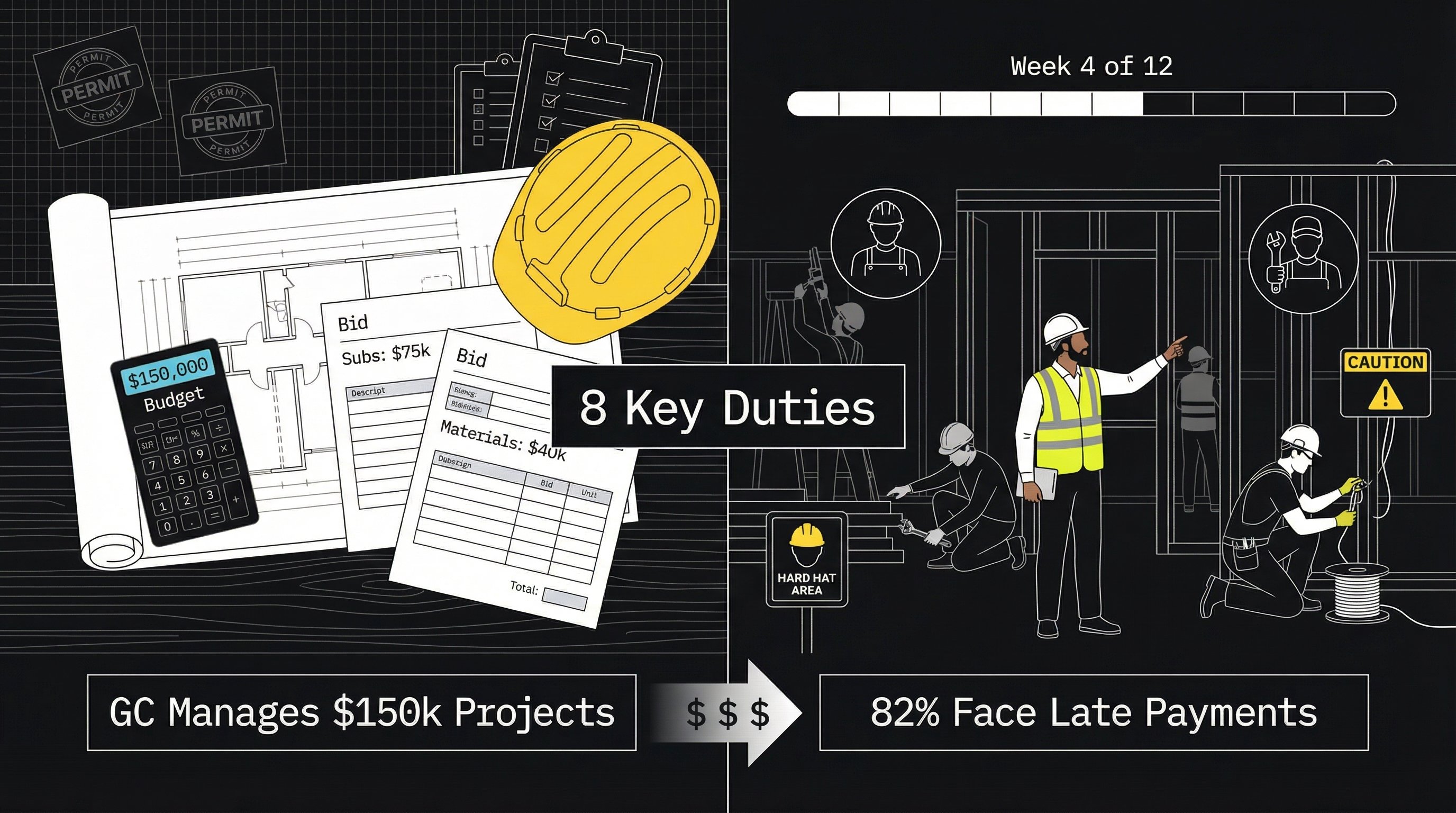
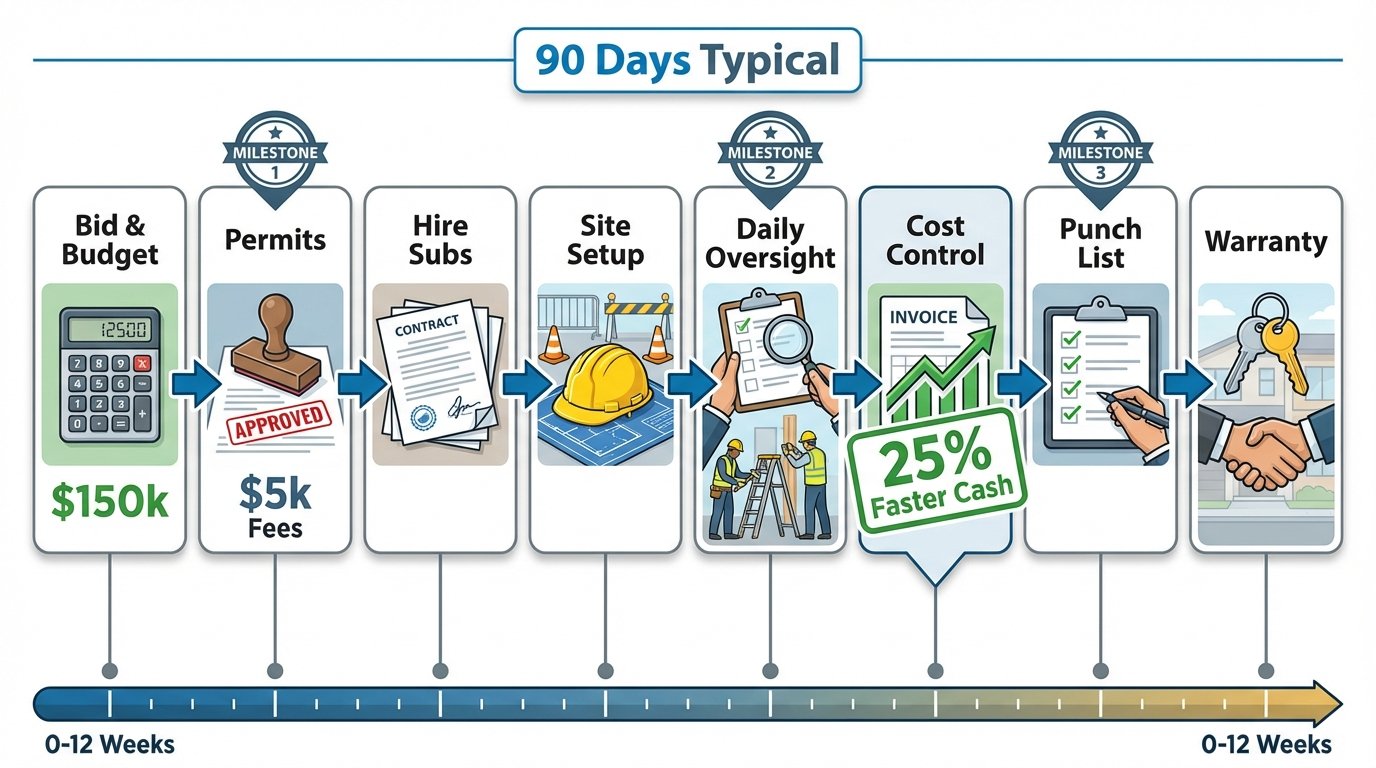
A general contractor oversees the full construction project, coordinating 5-15 subcontractors to deliver a $150,000 home remodel within 90 days. They bear liability for delays that plague 82% of jobs with payments over 30 days (PBMares 2024). You'll get their exact 8 duties, a comparison table, and an invoicing checklist proven to speed cash by 25%.
How general contractors secure bids and build project budgets
General contractors start by reviewing blueprints and estimating costs down to the $2,500 lumber order. They solicit bids from plumbers and electricians, then pad 15-20% for overhead and profit. For a $85,000 kitchen addition, expect $12,750 in subs, $17,000 materials, and $10,000 labor—totaling the bid.
Here's the thing: Owners underestimate change orders, which hit 25% of budget on average (AGC 2024). GCs negotiate fixed-price subs contracts to cap overruns. They present a breakdown spreadsheet showing milestones like "framing complete: 30% invoiced."
Verify bids against RSMeans data for realism—$45/sq ft framing in Midwest markets. This locks scope before shovels hit dirt. (Most skip detailed takeoffs, regretting 10% underbids later.)
What general contractors do to obtain permits and ensure compliance
GCs file for $3,000-$7,500 in permits, zoning variances, and inspections across 12 weeks. They confirm plans match local codes—like 2-hour fire walls in multi-family builds. Non-compliance fines average $1,200 per violation (ICC 2024).
They schedule utility locates and OSHA safety training for crews. Expect weekly site logs documenting barricades and PPE usage. Tools like Procore track digital submissions, cutting approval waits from 45 to 22 days.
Reality check: 14% of projects stall on permits (Dodge Data 2024). GCs front fees, recouping via contract allowances.
How general contractors hire and supervise subcontractors
GCs vet 10+ subs via licenses, bonds, and past $50k jobs. They draft scopes: "Electrician: Rough-in 20 circuits by week 4, $8,200 fixed." Daily, they hold toolbox talks and log progress photos.
Disputes? GCs mediate plumbing delays costing $500/day idle time. They enforce liens waivers before $15,000 payments. Sub performance dictates 70% of project success (Procore 2024).
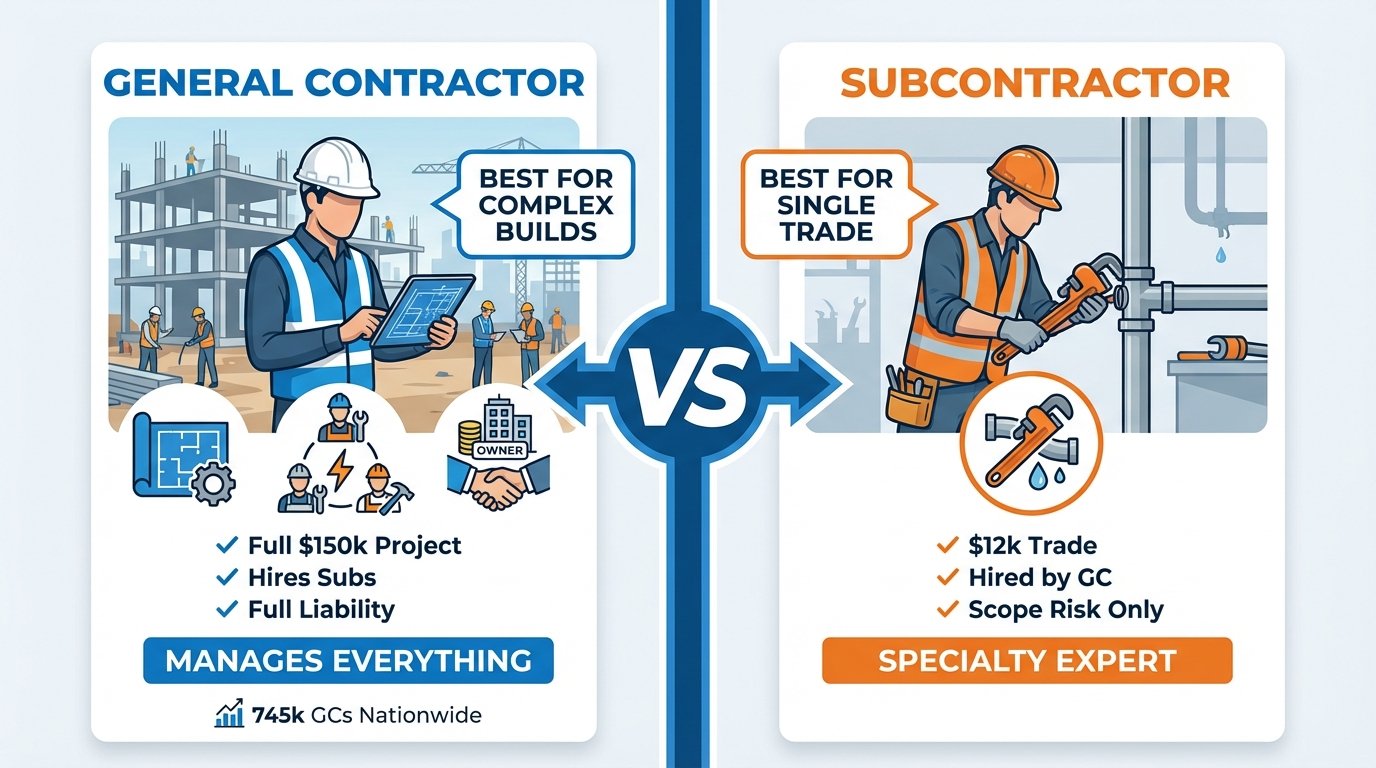
Key differences: General contractor vs subcontractor table

| Aspect | General Contractor | Subcontractor | Owner-Builder | Best For |
|---|---|---|---|---|
| Scope | Full project ($150k+) | Specialty trade ($10k wiring) | Self-managed subs | Complex builds |
| Contract | Direct with owner | Hired by GC | Direct with trades | Single trade |
| Liability | All delays/safety | Trade-specific | Full personal risk | Simple jobs |
| Payments | Progress draws | From GC invoices | Direct to subs | Source: BLS/AGC 2024 |
GCs absorb 100% risk, subs focus expertise. Bolded picks match situations.
Daily site management duties of general contractors
GCs arrive 7 AM for safety sweeps, then sequence trades—roofers before insulators. They resolve $2,000 material shortages via vendor calls. Afternoon punch lists fix drywall gaps before inspections.
You'll spot them photographing RFIs for $4,500 change orders. Weather delays? They accelerate HVAC next week. This oversight shaves 15% off schedules (McKinsey 2024).
How general contractors control costs and handle payments
GCs track variances weekly: Framing over by $3,200? Trim electrical. They invoice milestones—30% mobilization, 25% framing, balance at CO.
Late payments cost industry $280B yearly (Rabbet 2024). Use this checklist:
- Require 10% retainage until subs liens waived.
- Bill weekly under $50k jobs.
- Automate reminders—tools like PineBill cut delays 35% via bank syncs.
- Escalate to liens after 45 days.
Math: On $150k job, 30-day delay ties $37,500 capital at 12% interest = $375 lost.
Final walkthrough and warranty management by GCs
GCs conduct 2-hour punchouts, fixing 47 scuffs and $800 leaks. They hand keys with warranties—roof 10 years, appliances 5. Post-job, handle callbacks within 7 days.
This closes 95% projects defect-free (NAHB 2024).
Key Takeaways
- Oversee full project—GCs manage $150k budgets across 90 days, cutting delays 15%.
- Vet subs rigorously—Check bonds to avoid $500/day overruns.
- Invoice at milestones—30/25/20/25 split speeds cash 25%.
- Prioritize safety logs—OSHA compliance dodges $14k fines.
- Use digital tools—Automation halves admin from 10 hours/week.
- Demand liens waivers—Protects against $10k sub disputes.
Frequently Asked Questions
Sources
- U.S. Bureau of Labor Statistics - Construction Managers
- Associated General Contractors of America (AGC)
- National Association of Home Builders (NAHB)
- Rabbet 2024 Construction Payments Report
- PBMares Construction Payments Report
- McKinsey & Company - Construction Productivity
- OSHA Penalties
- International Code Council (ICC)
- Dodge Construction Network
- Procore Construction Management